
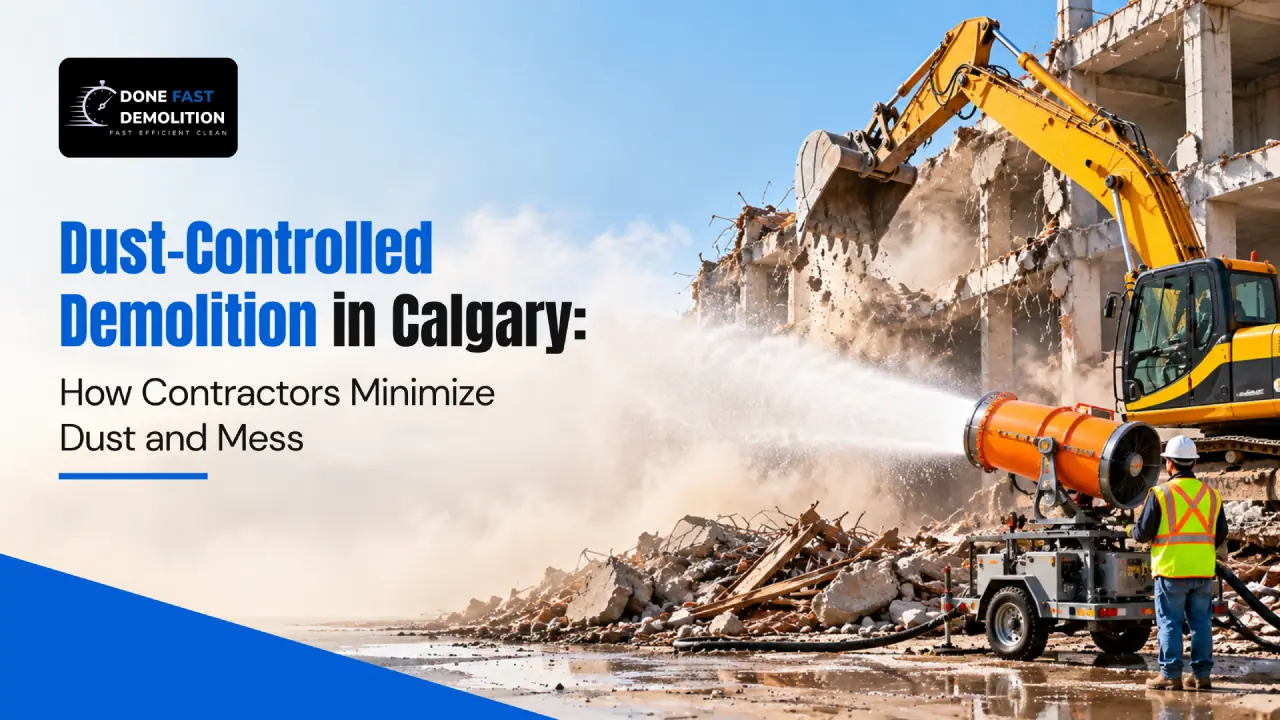
If you’ve ever walked past a demolition site, you’ve probably noticed how quickly dust can settle over everything around it. This fine dust can cause respiratory problems, affect neighbouring properties and increase project costs through additional cleanup or regulatory fines.
While dust may seem like an unavoidable part of demolition, there are several effective methods that contractors use for dust-free demolition while keeping the site under control.
In this blog, we’ll look at why dust control in demolition is important and the practical steps contractors take to minimize mess throughout the process.
Dust control is an important part of a well-managed demolition project. When a building is being demolished, dust and debris can spread across the work area and nearby places.
With proper dust-controlled demolition, contractors reduce these risks while keeping the worksite safer, cleaner and more manageable. Here are some of the main reasons why dust control matters during demolition:
Dust control is important because demolition can release fine particles that may affect the health of workers and people nearby.
According to the report of the Canadian Centre for Occupational Health and Safety (CCOHS), construction dust can cause serious health problems, including asthma, chronic obstructive pulmonary disease (COPD), silicosis and lung cancer. Some of the smallest particles can also reach deep into the lungs without being visible to the naked eye.
Keeping dust contained can help reduce unnecessary exposure during demolition, particularly when work is taking place in or near occupied spaces. This may involve using barriers, sealing openings and limiting access around the work area.
Workers are closest to the dust and may be exposed to it throughout the workday. But the impact does not always stop at the demolition area. When concrete, masonry or other silica-containing materials are cut, ground or broken, fine dust can become airborne and spread into nearby areas.
This can be a concern when demolition takes place in an occupied building, where dust may reach offices, hallways, neighbouring units or shared spaces. Alberta’s Occupational Health and Safety Code requires employers to minimize the release of silica and other harmful substances into the air as far as reasonably practicable.
Depending on the work and site conditions, contractors may use measures such as dust collection, wet methods, ventilation or containment to limit the amount of dust that escapes the work area.
Uncontrolled dust can settle on floors, walls, equipment and surfaces that were not part of the demolition work. Once that happens, the cleanup may require more time and labour before the area is ready for the next stage of the project.
Better dust control helps keep the affected area smaller and reduces the amount of post-demolition cleaning needed. This can make the transition to renovation, construction or the next phase of work more efficient.
Demolition dust can settle on floors, glass, equipment and other nearby surfaces. Fine concrete and masonry dust can be abrasive, potentially scratching finished surfaces or leaving a difficult-to-remove film. Dust can also get into filters, electronics and machinery, affecting equipment that needs to remain in use.
Protecting nearby areas before work begins can help reduce unnecessary cleaning and prevent damage to parts of the property that are not included in the demolition scope.
There is no single dust-control method that works for every project. The appropriate approach depends on the building, materials, demolition method, size of the work area and whether other parts of the property remain occupied or in use.
The contractors may use the following methods for dust-free demolition:
Water, mist or other wet methods are commonly used for dust suppression during demolition. Contractors can spray water to demolition areas, debris, and surfaces to help prevent dust particles from becoming airborne.
This method can help keep materials damp and reduce the amount of dust released when concrete, drywall, brick, and other materials are broken, cut or moved.
However, wet methods are not appropriate for every situation. Electrical equipment, water-sensitive materials, indoor conditions and other site factors need to be considered before using this approach.
In some cases, contractors may use specialized dust-suppression products where water alone is not the best option. These can include dust-binding liquids, which help fine particles stick together, or foam-based products, which cover dusty material and help keep particles from becoming airborne.
Some products are also added to water to help it spread over dusty surfaces and hold the particles in place. The right product depends on the material being demolished and where the dust is being created.
For interior work, one of the simplest ways to control dust is to stop it from reaching areas that are not being demolished.
Contractors may use temporary barriers, plastic sheeting, containment systems, or other barriers around specific work areas. These barriers can separate the demolition zone from finished floors, occupied rooms, hallways, or equipment that needs to remain in place. Openings may also be sealed to prevent dust from traveling through gaps, doorways, or building systems.
This becomes especially important during commercial demolition in Calgary. Removing walls in one tenant space is very different when another business is operating next door. The demolition area may need to be isolated to keep dust within the work zone.
When demolition is carried out inside a building or another enclosed space, ventilation and air extraction can help control dust. These systems move dusty air away from the work area rather than allowing it to circulate throughout the rest of the building.
For fine dust produced during concrete cutting or grinding, extraction equipment can be placed close to the tool to capture dust as it is created. On larger interior demolition projects, filtered exhaust systems may also be used to remove dusty air and maintain controlled airflow within the work area.
Airflow needs to be planned carefully. A fan pointed toward an open hallway or doorway can simply push dust into another part of the building. The aim is to draw air into the demolition area and direct it away from clean or occupied spaces. This helps keep dust contained instead of spreading it throughout the building.
Personal protective equipment (PPE) is the safety gear workers wear to protect themselves from dust and other hazards during demolition. Depending on the work, this may include respirators, safety glasses, gloves, and protective clothing.
Respirators help reduce the amount of dust workers inhale, while eye protection helps prevent dust and fine particles from reaching the eyes. The type of PPE used depends on the materials and work involved.
PPE is an added layer of protection alongside dust controls such as water, barriers, and air extraction.
The way materials are dismantled and moved can affect how much dust is generated.
Rather than creating unnecessary breakage, crews can use a controlled demolition method suited to the material and the project. Removed materials can then be handled and moved through planned routes to limit unnecessary disturbance.
For larger projects, Alberta’s demolition requirements also address how demolition materials are handled and how work areas are managed. For example, the OHS Code requires certain material chutes to be fully enclosed when they exceed the specified angle.
The goal is not to make demolition completely dust-free. It is to control where dust is created, where it travels, and how it is removed before it becomes a larger problem.
Dust-controlled demolition starts before the first section of a building is removed.
A professional contractor will typically assess the site, building materials, surrounding properties, access points, and potential sources of dust before work begins. This helps determine which dust-control methods are appropriate for the project.
During the work, contractors may use water, containment barriers, ventilation, extraction equipment, or other methods to keep dust from spreading. The approach can also change as different materials are removed or different parts of the building are opened up.
For example, demolition beside an occupied building may require stronger containment to keep dust away from people and nearby spaces. A project of interior demolition in Calgary may also need air extraction and filtration because dust can easily move through enclosed areas.
Dust control is therefore not a single task. It is an ongoing part of the demolition process, involving planning, suppression, containment, monitoring and cleanup.
Get the site assessed and understand the right approach for your project.
Dust-control demolition requirements can vary considerably depending on what is being demolished and where the work is taking place.
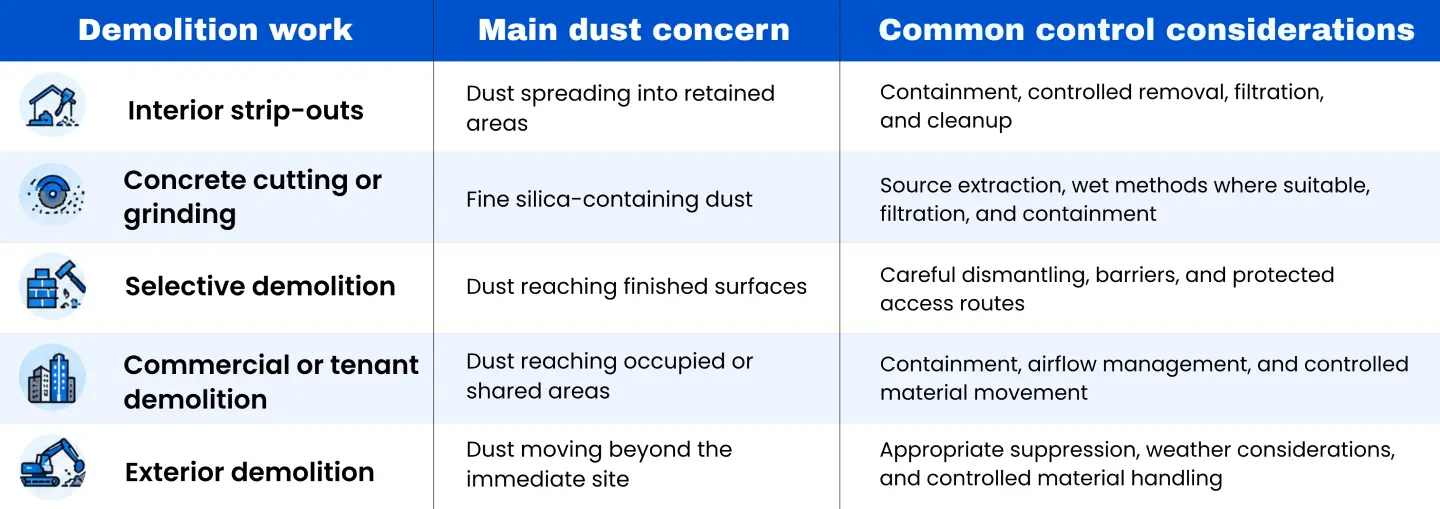
Dust control becomes more serious when demolition involves materials that may contain hazardous substances.
Older buildings may contain asbestos-containing materials, and disturbing them can release fibres into the air. Alberta’s OHS Code requires materials with the potential to release asbestos fibres to be removed before a building is demolished.
Alberta also requires notification to OHS at least 72 hours before activities that may release asbestos fibres, including certain demolition and renovation work involving asbestos.
This is one reason hazardous materials should be considered before demolition starts rather than after materials have already been disturbed. Other materials may also require special handling. The appropriate procedure depends on what is present, where it is located and the requirements that apply to the project.
Dust control is one part of choosing the right demolition contractor. A good contractor should also be able to explain how the entire demolition will be managed.
Look for specific information about containment, dust collection, filtration, airflow and cleanup. A clear answer is more useful than a general promise to “keep the site clean.”
Find out how the contractor plans to protect finished surfaces, occupied areas, building systems and access routes that are not part of the demolition.
Ask how potentially hazardous materials will be identified and what happens if asbestos or another regulated material is found.
Before hiring a contractor, review their insurance coverage, workers’ compensation coverage, relevant certifications and experience with the type of demolition being planned.
Make sure you understand whether the scope includes removal of demolition materials, cleanup of the work area and preparation for the next stage of the project.
A detailed scope makes it easier to compare contractors based on the work being provided rather than simply comparing the lowest number.
A demolition project is easier to manage when dust and site conditions are considered before the work begins. The right approach depends on the building, the materials being removed, the surrounding areas and the type of demolition involved. Taking these factors into account can help protect the property, reduce disruption, and leave the space ready for whatever comes next.
If you’re planning a demolition project in Calgary, Done Fast Demolition can help plan a dust-free demolition and determine the right approach for your site.


Ready to move forward? We provide detailed, no-obligation quotes within 24 hours.
$5M Liability & WCB Coverage.
Same-day replies for most requests.